

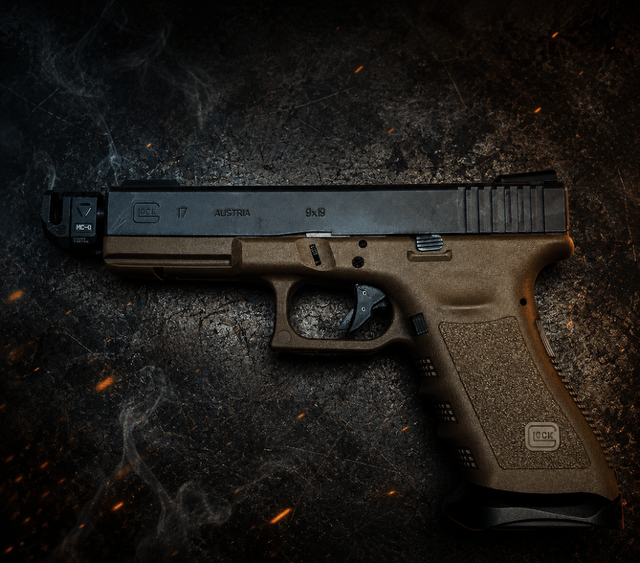
My Glock 17 Comped
The Strike Industries Mass Driver Comp on a Gen 3 Glock 17 turned my full-size 9mm into the flattest-shooting pistol I own. The change was clear during fast strings, where the front sight returned to the target with less lift and less delay.
That result raises a fair question: how much credit belongs to the compensator? Ammunition, grip pressure, slide mass, optics, stance, and shooter skill all affect recoil. My range impression is personal, not a universal test result, so the best way to judge the setup is to compare it with a stock Glock under the same conditions.
Why the Strike Industries Mass Driver Comp on a Gen 3 Glock 17 Shoots Flat
How the Mass Driver changes recoil
A compensator uses expanding propellant gas to push against muzzle rise. The Mass Driver takes a different installation approach from a standard threaded compensator. It uses a non-threaded, recoil-operated design built around its own guide rod and recoil-system parts.
The result is a change in recoil character rather than the removal of recoil. Felt recoil, muzzle rise, sight recovery, split times, and smoothness are separate traits. On my pistol, the biggest gain was faster sight recovery during rapid fire. The gun felt less jumpy, and the front sight stayed easier to track.
The exact design and parts can vary by model. Check Strike Industries’ current product documentation for compatibility, installation details, and approved components before buying or fitting one.
Why the Gen 3 Glock 17 makes a good host
The Glock 17 gives the system a full-size frame, a substantial grip, and a 9mm slide and barrel combination with a long record of aftermarket support. Its size also gives the shooter more room to manage recoil than a compact or subcompact pistol.
Slide mass, barrel length, grip fit, and recoil spring weight all affect how a Glock feels. A shooter with a firm, repeatable grip may notice the compensator more during fast shooting than during slow groups.
Gen 3 compatibility still needs a careful check. Confirm the exact Mass Driver model, Glock 17 generation, caliber, barrel setup, and recoil assembly. Do not assume that a part listed for one Glock variant fits every 9mm model.
Installation on a Mass Driver-Equipped Gen 3 Glock 17
Check the parts before fitting them
Before installation, verify the correct Mass Driver version for a Gen 3 Glock 17 9mm. Review the included recoil components, barrel interface, guide rod, slide fit, and any small hardware supplied with the kit.
Unload the pistol first. Remove the magazine, open the action, and check the chamber both visually and by touch. Field-strip the Glock according to its factory manual, then install the compensator and recoil parts by following Strike Industries’ current instructions.
A third-party video or an old forum post may show a different revision. Use the instructions supplied for the exact product in hand, and do not guess at torque values or change parts without a clear reason.
Inspect the system before live fire
After assembly, check that the slide moves freely and that the recoil assembly sits correctly. Confirm that the compensator is secure and does not contact the slide, frame, or barrel in an unusual way.
Perform the function checks recommended by Glock and Strike Industries. Look for looseness, peening, unusual contact marks, damaged hardware, or abnormal wear. Document the original stock setup before changing anything, since returning to the factory configuration can help isolate a later problem.
Range Testing the Strike Industries Mass Driver Comp on a Gen 3 Glock 17
Rapid fire showed the clearest difference
With the same grip and ammunition, my stock Glock 17 had a familiar upward snap. The Mass Driver-equipped pistol still recoiled, but the impulse felt smoother and more controlled. The front sight settled sooner after each shot.
The difference was modest during slow, deliberate fire. It became much easier to notice during controlled pairs, five-shot strings, and other drills that demand quick follow-up shots. The pistol seemed to stay closer to the aiming point, which made it easier to keep visual track of the front sight.
That does not prove a universal speed or accuracy gain. Shooter familiarity also matters. After several sessions with the modified pistol, I naturally became more comfortable with its timing and recoil pattern.
Ammunition can change the result
Record the ammunition brand, bullet weight, load type, temperature, and round count during testing. A higher-pressure or faster load may produce more gas and change how the compensator feels. A weak practice load may produce less compensation and may also create cycling problems.
Practice ammunition and defensive ammunition should be treated as separate test groups. A pistol that runs well with one load may behave differently with another, especially after changing the recoil system.
For a fair comparison, use the same distance, target, stance, grip, magazine capacity, and shooting cadence. A shot timer can record split times, while video can show muzzle movement and sight recovery. Group size and chronograph velocity add useful data, but the stock and compensated setups must be tested under matching conditions.
Reliability and Practical Tradeoffs Matter More Than Flatness
Track cycling and maintenance
A flatter recoil impulse has little value if the pistol fails to feed, extract, eject, lock back, or return to battery. Test the magazines and ammunition you plan to use, and record every stoppage instead of relying on memory.
Recoil-system changes can affect cycling, especially with low-powered loads, fouling, weak magazines, poor lubrication, or unusual temperatures. Keep a round-count log and note every part change.
The compensator and nearby parts can collect carbon. Inspect the mounting surfaces, guide rod, fasteners, and contact points during cleaning. Follow the manufacturer’s instructions for lubrication, service intervals, replacement parts, and acceptable wear.
Check holsters and carry plans
The Mass Driver changes the muzzle profile and may add length to the pistol. Some holsters may not fit, while others may allow extra movement or leave the muzzle poorly supported. Check fit with the exact Glock, optic, weapon light, and compensator combination.
The setup makes sense as a range or competition build for many owners. A carry pistol has stricter needs, including secure holster fit, tested ammunition, dependable cycling, and simple handling under stress.
Check local laws, range rules, and manufacturer guidance before using a compensated pistol for defensive purposes. A setup that works well on a practice day still needs careful testing before it takes on a more serious role.
Is the Strike Industries Mass Driver Comp on a Gen 3 Glock 17 Worth It?
Where the modification helps most
The strongest benefit is faster sight recovery during rapid, controlled shooting. A full-size Glock 17 gives the shooter a solid grip and enough frame length to make good use of that change.
The Mass Driver may be a strong choice for competition practice, high-volume range work, or anyone distracted by muzzle rise. It can also make long practice sessions feel less tiring when the shooter maintains a steady grip.
The upgrade will not fix poor trigger control, a loose grip, or an inconsistent stance. Better recoil control still comes from both equipment and practice.
Who may prefer the stock setup
Some shooters may not feel enough improvement to justify the cost and added parts. Others may prefer a standard threaded barrel, a stock recoil system, or a Glock that fits existing holsters without changes.
Reliability testing takes time. So do cleaning, inspection, and ammunition checks. If the pistol must run with one known load and one holster, a stock configuration may offer a simpler path.
Conclusion
The Strike Industries Mass Driver Comp made my Gen 3 Glock 17 9mm feel exceptionally flat, especially during rapid fire. The front sight returned faster, muzzle rise was easier to control, and follow-up shots felt more natural.
Those observations are personal unless supported by timed drills, video, chronograph data, and a documented round count. The value of the upgrade depends on verified reliability, ammunition choice, holster fit, and the shooter’s priorities.
For range shooters and competitors, the Mass Driver is worth testing. Verify model compatibility, follow the current installation instructions, compare stock and modified performance under matching conditions, and inspect the system regularly. On this Glock 17, the result was a clear improvement in shooting feel, but the right setup is the one that stays reliable while helping you shoot faster and track the sights better.


